DESTROY COLLECTION '82
Rei Kawakubo, Comme des Garçons, and the art of imperfection.


“Can beauty exist in imperfection?”
Parodi Costume Collection’s latest exhibition, In Praise of Ma: Emptiness and The Space Within, features objects from in Rei Kawakubo’s Comme des Garçons’ F/W 1982 Destroy Collection. While the entire collection challenged conventional ideas of beauty, PCC plays with the ambiguity and indeterminacy of a shawl scarf. At first sight, the object appears to be either a found ragged piece of cloth, or a raw and distressed cut of fabric. To many Western audiences, the distressed holes suggested poverty, destruction, or neglect. However, through the lens of Japanese aesthetics, these voids become an expression of negative space, the beauty of the passage of time, and an invitation to appreciate what is missing as much as what is present.


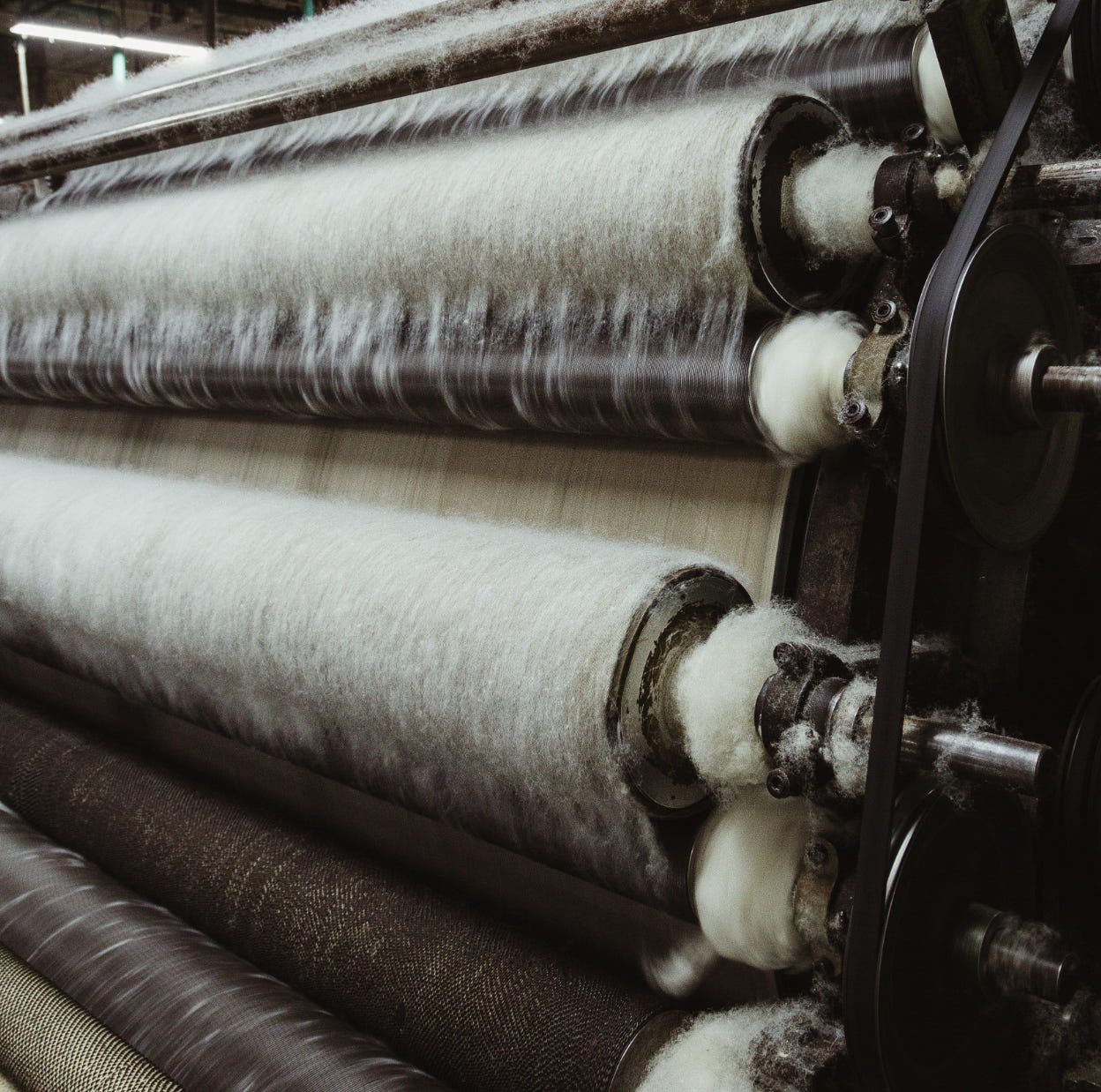
The distressed textiles throughout this collection featured holes and pulls. Rei Kawakubo’s version of “lace.” Specifically, this oversized shawl scarf is made from boiled wool. Before becoming a garment, it needed to be carefully selected and intentionally pushed away from its original state. Sheep wool is a renewable fiber made from keratin that must be sheared regularly; the fleece is then washed to remove lanolin, sorted, and spun into yarn. A process where the fibers are brushed and aligned into a continuous web. The yarn was then woven on a loom, crossing vertical and horizontal threads to create a stable textile. With an oversized shawl such as Kawakubo’s, the fabric must be dense. Therefore, it then undergoes a controlled process using hot water to wash, rub, and compress. The combination of heat and movement causes the wool fibers' scales to open and lock together. As the fibers tighten, the fabric shrinks, thickens, and becomes denser. Softly becoming a felt-like texture and losing clarity to its original weave. Once boiled, the fabric would be rinsed and dried. It could then be brushed or pressed depending on the desired finish. Known for its clean edges, Rei Kawakubo approached this material differently. Instead of hiding the effects of the process, she revealed them. The fabric’s imperfections became its decoration. By the time this shawl reached the runway, it carried a story, time, process, and absence within.
This shawl scarf was an entirely different philosophy of dress. No trends, solely concepts. The reactions reflected this. The collection was not titled “Destroy” by Kawakubo herself. The term was coined by an international audience. When entering Paris in the early 1980s, fashion was dominated by glamour, vibrant colors, and structured silhouettes. Once she arrived, she burnt pages. Prima facie, the public was horrified. Critics called it "Hiroshima Chic," depressing, and anti-feminine. The quality that stands out in Kawakubo is that she is not a fashion designer by training, or a part of a part of the established fashion narrative. Like Marcel Duchamp in the art world, she emerged to disrupt . Whoever approved or not, the consequence was irrelevant. She never featured tall stilettos on her runways, nor models with makeup or styled hair. Her clothes were there to question concepts, standards and Ideals. Not creating “for men” nor “for women”. This is why the critics, media, and general audience disapproved of her; they rejected proposals that negated continuity or conventional standards.
At the onset of COMME des GARÇONS the visual language of Eastern and Western fashion diverged. While Western fashion magazines of the early 1980s were highly polished and idealized, Kawakubo offered something entirely unfamiliar. From the perspective of photographers Peter Lindbergh and Hans Feurer, Kawakubo's philosophy was translated into a language that Western audiences could begin to understand. Lindbergh emphasized raw emotion, humanity, and intention of texture, while Feurer captured their energy through unconventional framing, movement, and dynamic composition. Neither photographer sought to "correct" Kawakubo's vision or soften its nature. Instead, they embraced its individuality, allowing the garments to be understood not simply as fashion, but as expressions of a new way of seeing. These photographers and many more who worked alongside COMME des GARÇONS articulated a compelling narrative of Kawakubo’s work. She gave them complete, unrestricted creative freedom to photograph her collections, effectively creating one of the most iconic collaborations in fashion.


The photographers who worked alongside Kawakubo and her vision: Kazumi Kurigami, Bruce Weber, Arthur Elgort, Hans Feurer, Paolo Roversi, Eddy Kohli, Steven Meisel, Oliviero Toscani, Deborah Turbeville, Sarah Moon, Peter Lindbergh, Hans Feurer.
More than four decades later, the “Destroy Collection” endures as one of Kawakubo’s defining statements, transforming destruction into construction and proving that beauty emerges not despite imperfection, but because of it.
Research and writing by Vanessa Viveca Steinberg
—
Follow us on Instagram @parodicostumecollection for behind-the-scenes access to the archive, exhibition updates, internship opportunities, and stories from the collection

 | A guest post by
|