


Space when occupied—not just in the cosmic sense of rocketships and satellites, but in the physical embodied sense—invites its inhabitants to dissect their presence and question how it disrupts, invites, and reveals. In the 1960s, Space Age wasn’t just about reaching the moon—it was about reimagining humanity's relationship to space on Earth: how we move through it, how we perceive it, and how we express ourselves within it. Artists and designers responded by breaking down traditional boundaries between the viewer and the object, as well as between clothing and sculpture, and surface and depth. For Jesús Rafael Soto and André Courrèges, space became both a subject and a medium of expression.
Courrèges, formally trained as an engineer, brought a systemic, architectural logic to his approach to fashion design. He elevated garments beyond decorative items, as frameworks for motion, efficiency, and speed. His silhouettes emphasize modularity and utility—A-line skirts, pant suits, and catsuits —creating a visual rhythm that echoes the geometric purity and principles of industrial design. By the mid-1960s, Courrèges had embraced a distinctly futuristic aesthetic characterized by crisp white wool, sculptural plastic forms, metallic accents, and tailored silhouettes that delivered functionality and aspiration. Courrèges' design philosophy propelled society into a future in which women moved freely, confidently, and visibly through space.
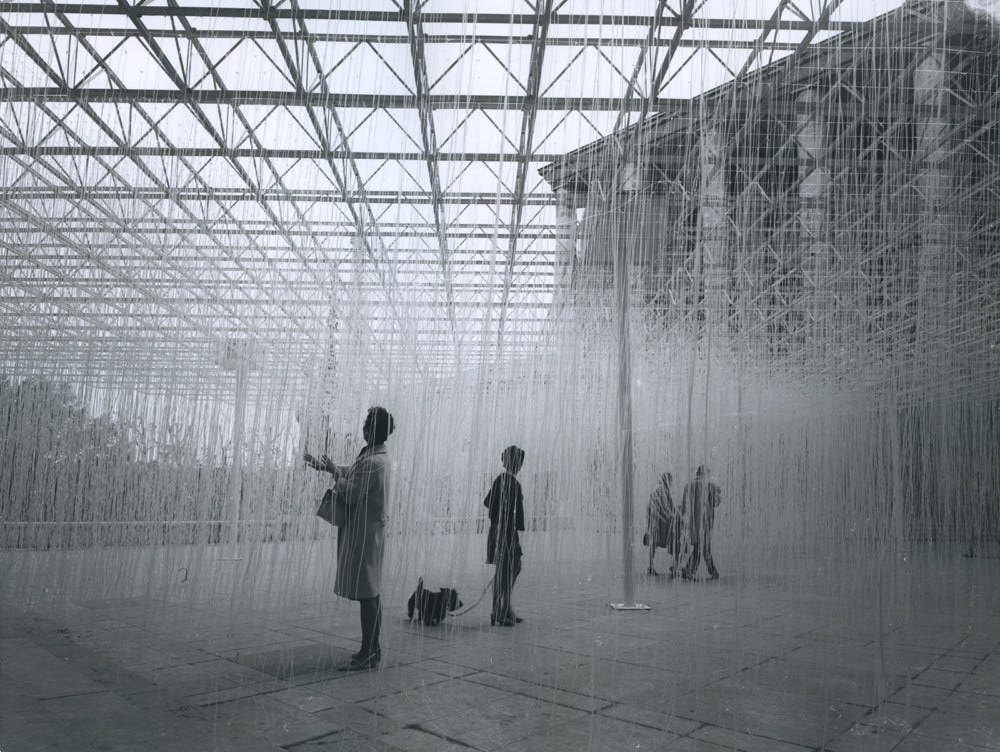
In parallel, Soto dissolved the physical and symbolic boundaries of traditional sculpture through his series of works titled Penetrables. Emerging from the kinetic art movement of the 1950s and 60s, his work sought to erase the solidity of form in favor of vibration, optical instability, and immersion. Soto’s Penetrables, forests of hanging filaments often made from PVC tubes or nylon thread, invited the viewer to step into the artwork’s shifting visual field as an active participant instead of a passive observer. Soto explains, “in the Penetrable, the beholder is really part of the work. The Penetrable is a work that has attained its object. It can be reconstructed without my help. I think that is the real meaning of conceptual art” (qtd. in Corso 131). Redirecting the focus of sculpture away from static observation and toward spatial immersion, Soto’s work absorbs his audience, as bodies seem to dematerialize within each filament forest.
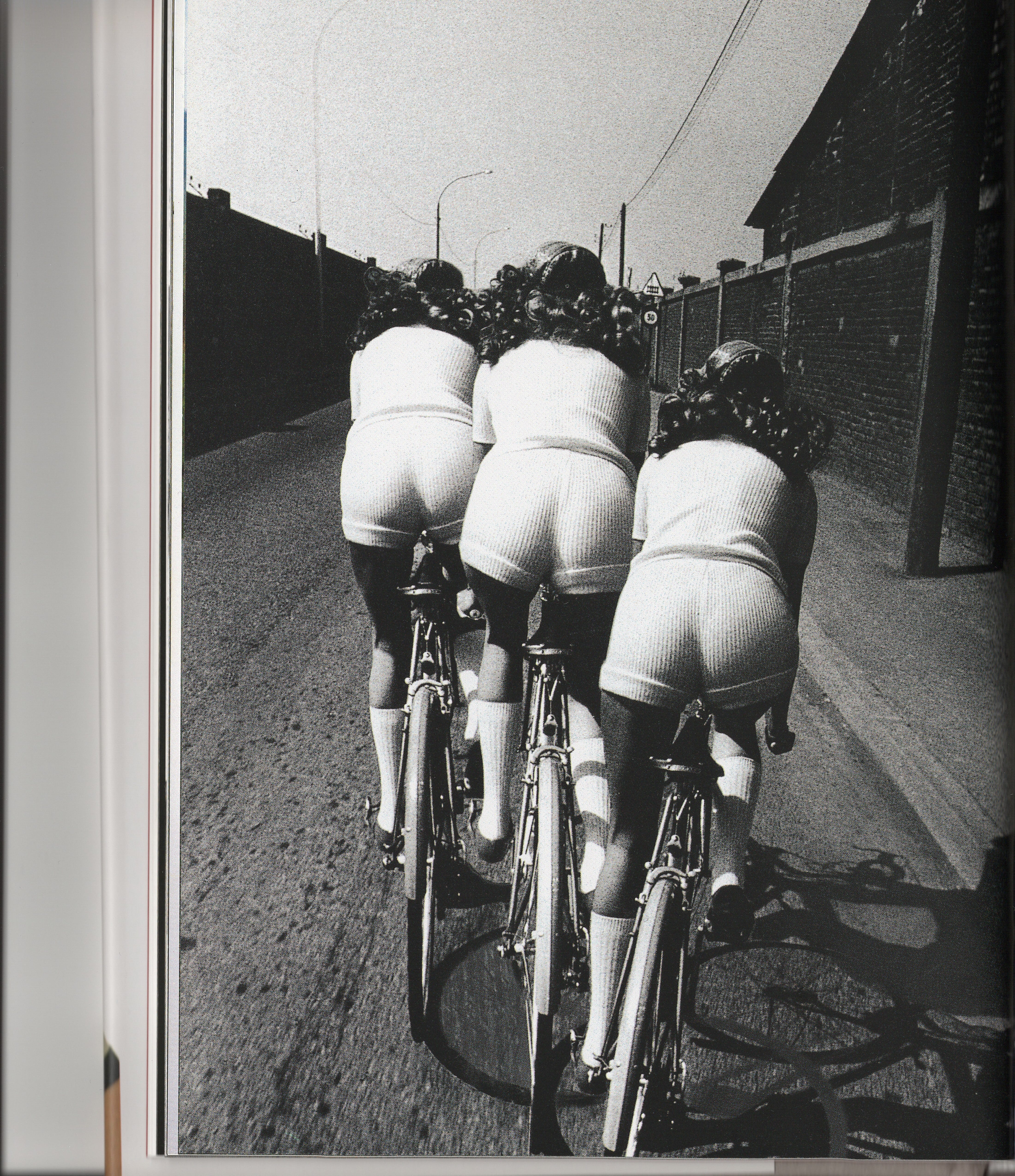
A Courrèges film, published in Paris in 1969, captures a rare moment in which the designer's and artist’s sensibilities converge. Models move within the shimmering curtain of a Penetrables installation, showcasing the Courrèges Fall/Winter Collection.
The garments—characterized by sleek knits, bodysuits, woven accessories, and metal detailing—seem to pulsate within the fragmented angles created by the installation. This moment in time marks a critical intersection between the fashion industry and visual art, where clothes are not merely worn but activated through their integration into the space surrounding them. The film documents this convergence, where bodies serve as both model and medium, navigating an environment that deconstructs perception and challenges static display, effectively dismantling the transitional boundaries between disciplines.
This sensibility endured well beyond the 1960s—Soto’s 1996 collaboration with Rei Kawakubo at the Comme des Garçons Aoyama Boutique in Tokyo extended his perceptual language into the realm of commercial space, transforming the store into a dynamic field of optical play and spatial disorientation. Including the following citation from Soto in the boutique’s exhibition flyer, Kawabubo followed in the precedent set by Courrèges to invite her client base to see Comme des Garçons through Soto’s dynamic lens:
“Artistic creation is a force which should preferably be directed towards the exploration of space….., of the universe….., of the infinite realities which surround us, but of which we are hardly conscious.”
Soto's penetrable environment isn't just a backdrop, but functions as a force field, altering the way Kawakubo’s work is seen, how movement is registered, and how space is perceived. The 1996 exhibition is just a fragment of Comme des Garçons Space Age influence, building on the elements of construction and modularity introduced during the inception of space exploration.
This precise juncture anchors the curatorial logic of our current exhibition. Fashion in Orbit, curated by Ab Thielen and Valeria Fajardo, showcases garments from Courrèges and other pioneers of Space Age fashion, connecting them to contemporary designers through the end of the 20th century into modern day. The museum’s main gallery showcases this 1969 video not merely as a historical artifact, but as a hinge connecting disciplines, design philosophies, and modes of perception. Paying homage to Soto’s influence on fashion design, two grids of PVC tubing with Courreges’ designs float in the center of the exhibition. Bridging Soto’s immersive spatial environments to the impact of Courreges’ design philosophy, the installation acts as a reminder that space is not just a stage for movement—it can also be an active medium through which meaning is constructed.
Fashion in Orbit reactivates this moment in fashion and art history by reframing fashion as part of a larger perceptual system, one that is immersive, interactive, and spatially engaged. For both Soto and Courrèges, meaning emerges through participation. Clothing becomes kinetic sculpture; the viewer becomes performer.
Text by: Caroline Sosler.
Citations
Corso, John J. “Public Penetrations: Jesús Rafael Soto’s Entry into Political Art.” RACAR: Revue d’art canadienne / Canadian Art Review, vol. 38, no. 2, 2013, pp. 124–134. Érudit, doi:10.7202/1020798ar erudit.org.
“Solo Exhibitions – Jesús Rafael Soto – from 1949 to Today.” Jesús Rafael Soto – Kinetic Art, jesus‑soto.com, n.d., https://jesus‑soto.com/solo‑exhibitions‑soto‑kinetic‑art/.
Soto, Jesús Rafael, and Oscar Ascanio. Soto Space Art. 1985.